Education and Prison
Exploring Education’s Role in Reducing Recidivism.
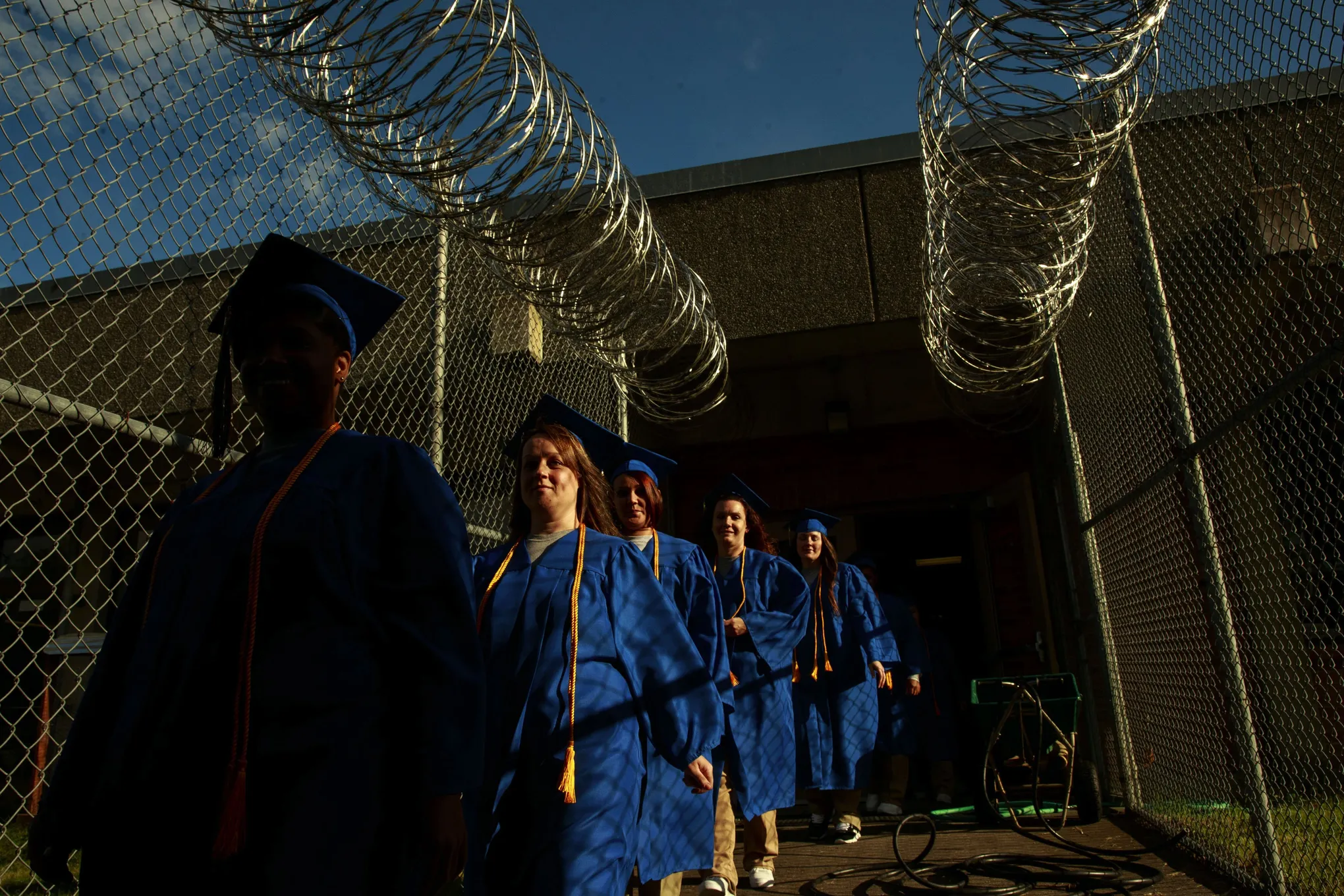
What is Recidivism?
Recidivism is “the tendency of a convicted criminal to reoffend.”
– Oxford Languages
“It [Recidivism] refers to a person’s relapse into criminal behavior, often after the person receives sanctions or undergoes intervention for a previous crime.”
– National Institute of Justice (NIJ)
Our Project
Our project examines the relationship between education in prison and its effects on recidivism rates. Generally, recidivism rates tend to be lower for inmates who received higher education before incarceration as well as those who attended programs within prison. We found that education programs in prison significantly reduce recidivism rates and that vocational training in prisons has a strong impact on increasing labor force participation post-release. For example, a 2013 RAND meta-analysis of 58 studies analyzed the effectiveness of correctional education programs and found that inmates who participated in correctional education programs had 43% lower odds of recidivating than inmates who did not (Davis, 2013). Education as a recidivism tool is highly beneficial as after the offender obtains an education, this benefit is shared with their family, the correctional institution, and society as a whole over time (Hall, 2015). A study analyzing 10 empirical studies published between 1995 and 2010 examined the impact of correctional education programs on recidivism and concluded that college education during incarceration has the greatest impact on decreasing recidivism. Beyond the societal impact, correctional education programs have economic benefits as well. Education in prisons is cost-effective for students, correctional facilities, and state administrations because it costs more for reincarnated individuals with no correctional education than for those with the education.
The data set we are using is from the Georgia Department of Community Supervision and the Crime Information Center of the Georgia Bureau of Investigation. The data shows 26,000 inmates who were released from prison in Georgia. This data set is relevant to our topic as it provides personal information on each of the 26,000 prisoners from their gender, race, and age at release to prior arrest and conviction history, number of residency changes post-release, and the number of jobs post-release. By analyzing this data, we can identify the individuals most at risk of reoffending, enabling us to focus correctional education efforts on vulnerable populations.
Research Questions
How do different demographic factors influence an individual’s likelihood to participate in prison education programs and subsequent success in reducing recidivism?
What specific educational interventions in prison are most effective at reducing recidivism rates and promoting successful reintegration post-release?
What role do additional support services, such as psychological counseling, vocational training, and job placement assistance play in further reducing recidivism?
Timeline
The United States prison system is a complex and extremely flawed body, with roots in slavery, colonialism, and basic imbalances of power built into our country. The prison system had its beginnings with the Quakers in the 1700s (Alduraywish, 2022), but wasn’t officially established until 1891, with the congressional “Three Prisons Act” (Federal Bureau of Prisons). Over centuries, there has been continued discourse over the role of prisons in our society, and the effectiveness of their correctional intent. The prison reform movement began in the late 1800s as a way to advocate for safer conditions for imprisoned people and a greater emphasis on rehabilitation rather than punishment. The prison reform movement emerged in response to changing conditions in the US including the rise of industrialization and of poverty. Prison reform ideas question the misuse of power in the system, and investigate ways in which prisons could be improved to truly help people improve their lives and return to society in a more humane, beneficial way. A large component of the Prison Reform Movement is the offering of educational services to imprisoned persons. The first school recorded in an American prison was in 1789 when a clergyman began teaching inmates at the Walnut Street Jail in Philadelphia, and the Pennsylvania Prison Society founded in 1787, is said to have begun the Correctional Education Movement in the United States. Beginning in the 1830s, Harvard Divinity School instructors began tutoring inmates at the Massachusetts State Prison, and in 1913, 50 inmates at a Kansas federal prison enrolled in the state’s Agricultural College, one of the first college programs in a prison (Norweg, 2021). The 1960s brought the first live college instruction to inmates in Illinois, and the establishment of a college prison program in Texas that was proven to reduce recidivism (Norweg, 2021).
Place in Literature
Many studies show a positive correlation between education and successful reentry into society (Figure 1). Magee presents comparative research across various states and countries, showing that recidivism rates decrease with the introduction of educational programs in prisons and the provision of job training (Magee, 2021). However, Newton et al. argue that the connection between education and recidivism is not strong enough to be conclusive (Newton et al., 2018). Their study found that two years after release, recidivism rates were similar to those in the control group. The authors contend that factors such as economic conditions, substance abuse, and stable employment play a more significant role in influencing recidivism. Mertanen and Brunila support this perspective, emphasizing the importance of psychological support for prisoners (Mertanen and Brunila, 2018). Through interviews, inmates and their mentors highlighted the greater positive impact of psychological assistance over educational programs. While education can assist prisoners in transitioning to society, it is clear that other factors, such as individual circumstances and abilities, also play a significant role in rehabilitation.
The question of the most effective approach to rehabilitating former criminals remains open, presenting a field for further research. However, this project aims to synthesize the conflicting findings in the literature surrounding the impact of education on recidivism rates. By incorporating these contrasting perspectives, our project provides a more nuanced understanding of the relationship between prison education and recidivism. We argue that education alone may not be the sole solution, but when combined with factors such as vocational training, post-release job placement, and psychological support, it has the potential to significantly improve reintegration outcomes and decrease recidivism. This synthesis contributes new insights by highlighting the importance of a holistic approach to rehabilitation, where education is just one part of a broader strategy. Furthermore, by analyzing the specific types of education programs and populations that benefit most, we add clarity to how correctional education efforts can be more effectively targeted, particularly for those at the highest risk of reoffending.

Figure 1: Compares education levels to recidivism rates within three years for individuals with varying educational attainment: “At least some college,” “High School Diploma,” and “Less than HS diploma.” Each category is represented by a pie chart showing the proportion of individuals who either did (orange) or did not (blue) recidivate within the timeframe. The data highlights a higher likelihood of recidivism among individuals with lower educational attainment.
Significance
The topic of this project is very valuable as it investigates the types of people that re-offend, attempting to gain a better understanding of how the prison system and society as a whole can help target these vulnerable populations. Throughout our research, we found a wide range of information about the kinds of education that are most effective in reducing recidivism, whether that may be post-secondary education, vocational training, etc. However, what this project aims to conclude is not a simple solution for the best kind of education and the most effective program for specific cases, but rather a clearer understanding of who the implementation of high-quality education needs to target.
We saw a clear correlation between the level of education a person received before their first incarceration and their likeliness to re-offend. We can use this information to not simply bring awareness to the impact of receiving education, but look more critically at the factors of education that might be influencing this correlation. For example, it is possible that it’s not simply the topic discussed in the education they attain, but rather the sense of structure and accountability that education demands of its students. When a person goes to prison for crimes, they are introduced into a different society. While in prison, the prisoner is deprived of their usual environment, connection with relatives, and freedom of movement.
Maintaining connection with the outside world is important in order to remind individuals that their current situation is temporary in hopes of motivating them to focus on self-improvement and personal growth. It suggests hope for those who have stumbled and offers a solution that is worth trying. This topic holds significance as it instills hope in those who have faltered and presents a solution worth pursuing. Overall, analyzing what qualities of education are most important in lowering recidivism rates can provide valuable information on the specific policy changes that need to be made within education and the features of programs provided in prison. This information does not just allow a deeper level of understanding surrounding education in and for prison but also aids this understanding in expanding into further pushes for changes within education.