Main Findings

The U.S. incarceration rate has nearly tripled since 1980, reaching 5.4 million in 2022 (Bureau of Justice Statistics, 2022). An all too common phenomenon exposes those incarcerated as being so disheartened and dehumanized by the system and their environment, and the lack of growth and opportunity, that the acceptance of crime seems to be a survival response, the only way to continue to live. This dehumanization by the American system as a whole is deeply internalized, making it seem impossible to believe that one could be valued and accepted in the wider society. As a result, some individuals engage in criminal behavior because they see it as a way to survive, convinced that it is a shortcut to wealth and success. This raises doubts about their ability and willingness to change their lifestyle and become a contributing member of society, which is one reason why many individuals re-offend. Imprisonment serves as a punishment for crime, but its effectiveness in reforming individuals who have already embarked on a destructive path varies. The ability to reintegrate into society and become productive members of a community depends largely on the opportunities provided to prisoners. One powerful tool in enacting change is education.
Comparison of Three Year Recidivism Rate to Education Rank By State

Figure 2: illustrates a heat map of education rank by state with 1 being the highest rank and 50 being the lowest rank, based on two factors: education attainment and quality of education. This ranking combines both of these factors taken from data in 2024, and assess the overall position of each state in comparison to the others. The highest ranked states (1-15) are predominantly along the east coast and northwest. However, the lowest ranked states (40-50) are appear to be more predominantly in the south and midwest regions.

Figure 3: illustrates a heat map of recidivism rates across the United States states, reflecting individuals released from prison during 2017–2018, as the standard tracking duration for recidivism is three years. States with no available data from that year are replaced with percentages from other reported years, as reporting recidivism is not mandatory each year. The following states include figures from other years: California provides rates from 2017–2018, Hawaii includes overall recidivism rates from 2015, North Carolina and Georgia report rates from 2019, and Rhode Island provides its most recent data from 2021. The states with the lowest recidivism rates (around 13-25%) are concentrated in the northwestern and northeastern regions of the country, while the states with the highest recidivism rates (over 40%) are primarily in the southern and midwestern regions.
The Role of Education in Prisons
“Effectiveness of Correctional Education System in Georgia State Prisons: Labeling Theory as Sociological Approach” investigates the effectiveness of the correctional education system in America by focusing on Georgia State Prisons (Alduraywish, 2022). The article illustrates the role prisons were initially intended to fill: to ensure public safety and reform prisoners. It discusses how education was introduced during the 1800s in various prisons, but generally was abolished during the 1900s as it took away from valuable labor time in a newly industrialized society. In the 1980s, education programs flourished, and Pell Grants were created to support college and vocational schools in prisons (Alduraywish, 2022). Nowadays most state correctional institutions offer some type of correctional education, such as secondary or GED education, vocational training, special education, and college courses (Alduraywish, 2022).
“Getting the Debate Right: The Second Chance Pell Program, Governor Cuomo’s Right Priorities Initiative, and the Involvement of Higher Education in Prison” introduces the critical consideration of why we support education in prison, and the necessity of questioning the role that prisons play, and the role that it should play in human rehabilitation (Conway, 2020). Conway’s argument provides thoughtfulness on the matter, arguing that the way prison education programs are being justified and defended is currently insufficient and wrong. He believes that the current thought–argument of how prison education reduces recidivism–rates as a sole way to support various prison education initiatives puts the long-term viability of prison education systems at risk. Instead, Conway says we should focus on how “Prison education is a moral and ethical responsibility” that allows us to provide some counter to the inequalities in our justice system. Conway also discusses a paradox. Prison education is meant to encourage personal growth, and sense of self, and a greater thoughtfulness, sensitivity, and curiosity about the world. However, the prison school environment structurally cultivates dehumanization and restriction. Focusing on recidivism rates as the sole justification for prison education over a greater dedication to improving incarcerated people’s “cognitive liberation”, and increased sensitivity to others is a grave mistake.
In addition, Conway states that there is a firm necessity for assessment and questioning of the current prison system, in which there is a clear differentiation of incarceration rates based on race, ethnicity, and economic status. As Conway says, “It is not just ‘bad’ people who end up in prison…the all-too-common perception that it is only the malevolent who become incarcerated is naïve and profoundly incorrect.” Extensive research points to the link between incarceration and the deep-rooted social inequities from historical and ongoing injustices such as unresolved legacies of slavery and racial discrimination (Conway, 2020). Punishment and incarceration are not evenly distributed through class, race, ethnicity, and education level (Figures 4 & 5). Black people make up 13% of the total U.S. population yet comprise nearly 40 percent of its prison population (US Census Bureau, 2011). Males who grew up in families within the bottom 10% of income distribution are 20 times more likely to be imprisoned in their early thirties than those in the top 10% (Conway, 2020). These statistics clearly demonstrate that there are underlying, systematic factors that impact the type of person who is likely to be incarcerated. It is a complicated but very clear directive that there should be a systematic response in counterbalance. We should work to provide services that treat incarcerated people as human, and as humans that are able to “cultivate thought, expression, intellectual curiosity, constructive dialogue, and debate”, and who are valued humans.

Figure 4: A pie chart that depicts the racial breakdown of individuals who recidivated within three years of release. The chart shows that 58.46% of those who recidivated are Black, while 41.54% are White, highlighting disparities in recidivism rates between these two groups. This disproportionate ratio points to underlying social, economic, and systemic factors influencing recidivism outcomes
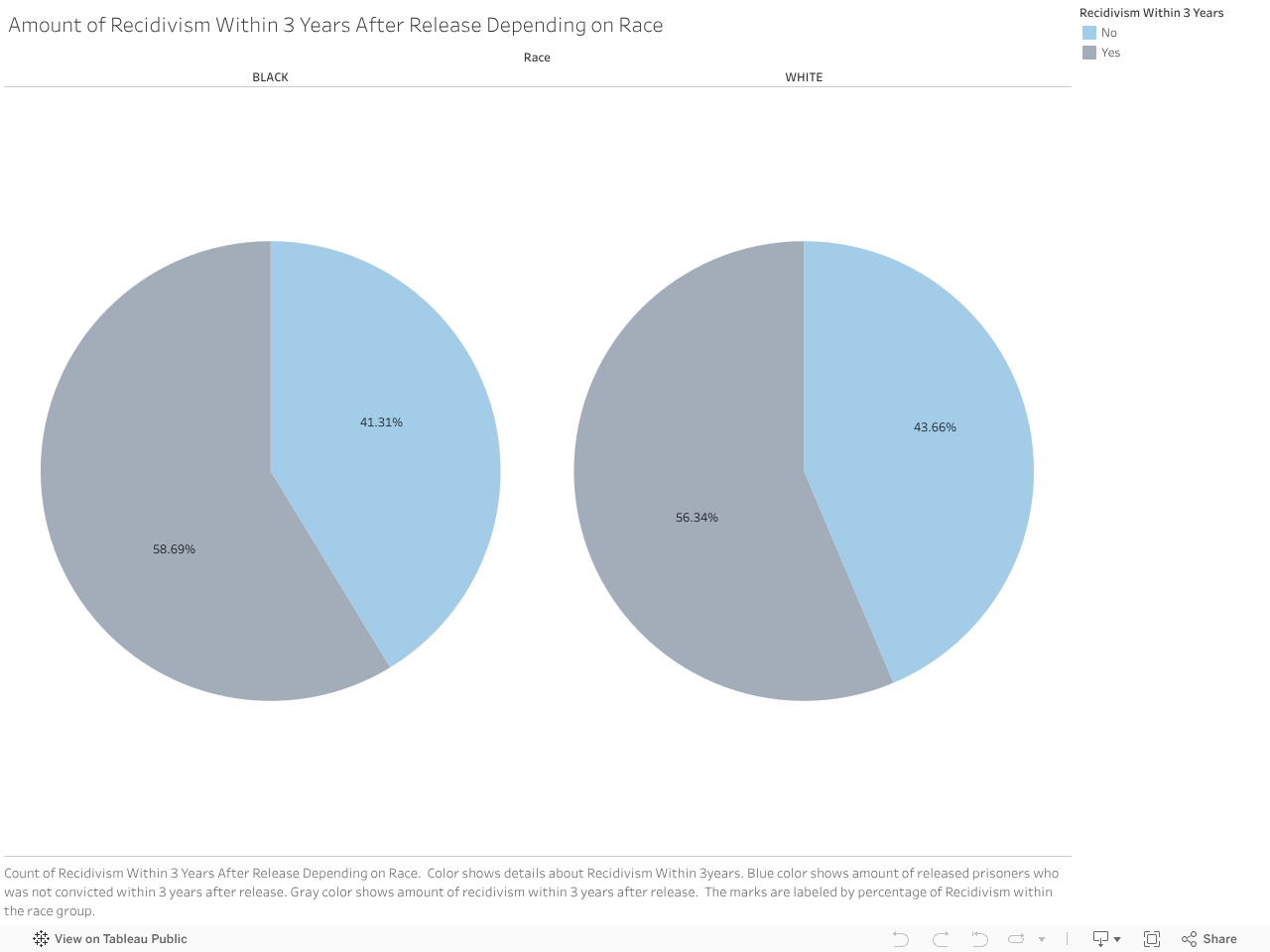
Figure 5: A pie chart that illustrates the percentage of individuals who recidivated within three years of release, categorized by race (Black and White). It shows that 58.69% of Black individuals and 56.34% of White individuals reoffended during this period. The data highlights that while there is a slight difference in recidivism rates between the two groups, recidivism remains a significant issue across racial categories.
Different Levels of Education Impact Recidivism
The U.S. Bureau of Labor Statistics reports that the vast majority of criminals do not have a high school education and do not have a stable income (Magee, 2021). Prisoners with a high school diploma or less who are affiliated with gangs have the highest likelihood of reoffending within three years, with recidivism rates of 81.66% and 78.5%, respectively (Figure 6). In contrast, non-gang-affiliated prisoners with the same educational background have lower recidivism rates of 57.35% and 58.12% (Figure 6). Overall, inmates with at least some college education are significantly less likely to re-offend compared to those with only a high school diploma or less (Figure 6).

Figure 6: People with a high school education or less have a higher recidivism rate
This observation is not unique to the United States; studies in Canada, Italy, and Sweden also show an interconnection between unemployment and crime rates (Magee, 2021). The Georgia Department of Corrections declares that “offenders who engaged in education programs while incarcerated exhibited lower rates of recidivism after three years, and their incomes were higher” (Alduraywish, 2022). Correctional education programs have proved to play significant roles in reducing recidivism and encouraging labor force participation (Alduraywish, 2022). Data shows that the average annual salary for positions requiring a high school diploma or its equivalent (GED) is 1.5 to 2 times higher than the average annual salary in less educationally demanding occupations (Magee, 2021). An associate’s degree or bachelor’s degree increases the average annual salary by 3 times (Magee, 2021). Thus, a person who has received the appropriate qualifications or formal training becomes a more preferable choice for an employer.
Vocational training in prison reduces recidivism by providing trade skills and practical experience, which lowers the likelihood of unemployment after release and enables individuals to support themselves (Magee, 2021). Magee cites studies in several states that show significant reductions in recidivism rates for those who received correctional education compared to those who did not participate in any educational programs offered in prison (Magee, 2021). The most striking result was found in Maryland, where over the course of a three-year study, no one was returned to prison after receiving an education (Magee, 2021). Regardless of whether a prisoner has served less than 1 year or more than 3 years, those who have lower program attendance are most likely to re-offend (FIgure 7). Notably, individuals who served less than one year and attended 3 or fewer programs have the highest recidivism rates (Figure 7). Conversely, prisoners who have been in prison for more than 3 years and participated in 10 programs exhibit the lowest recidivism rates (Figure 7).
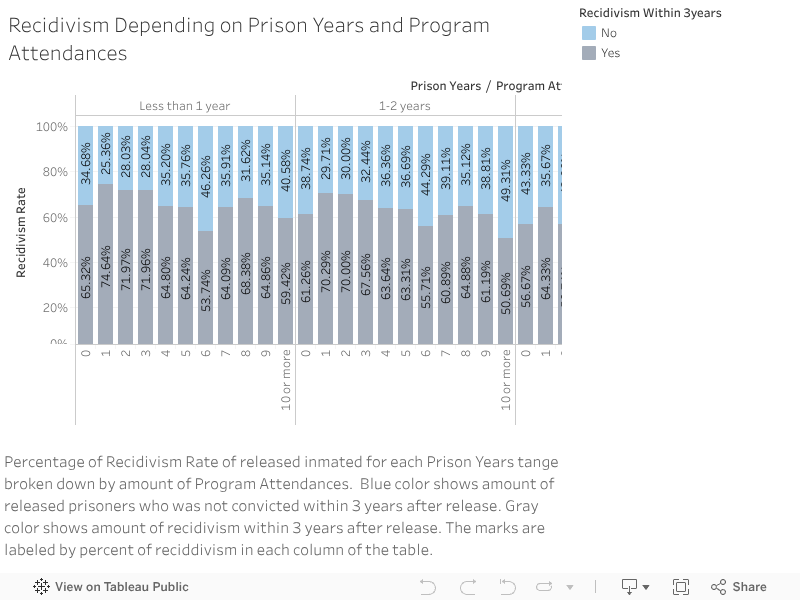
Figure 7: People who have lower program attendance have a higher recidivism rate
Note: We do not have a definitive answer as to what these “programs” are, indicating a major limitation of our analysis. Through investigation on the dataset source website and further research into various programming in the Georgia prison system, we have made an informed inference that this programming is in reference to a variety of educational, vocational, and rehabilitative training. In our analysis, we use this “Programs” data to investigate the impact of general rehabilitative and enrichment opportunities.
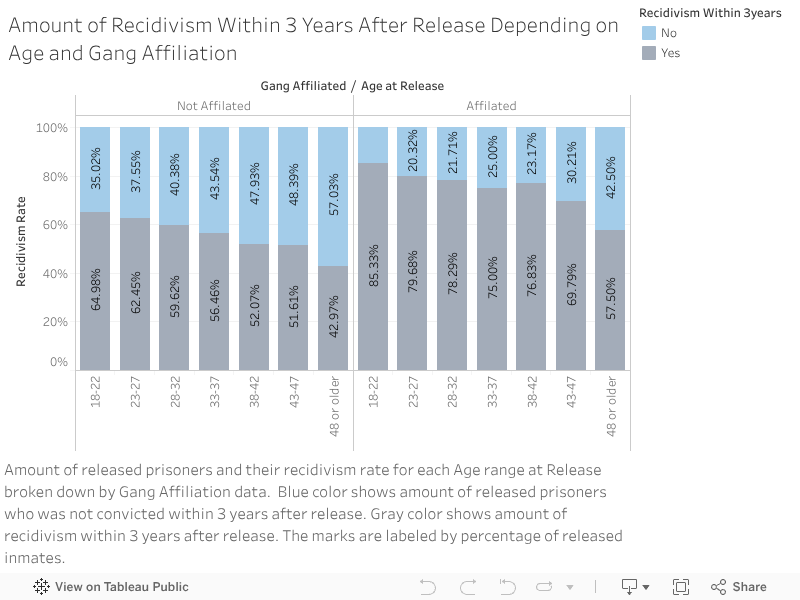
Figure 8: Recidivism rate decreases with age
On the other hand, Newton et al. (2018) questions the strong link between education in prison and recidivism. They selected 12 studies that met strict criteria for using experimental or quasi-experimental designs and concluded that recidivism rates are not strongly influenced by education but rather by other factors (Newton et al., 2018). Several programs in different parts of the United States have shown little change in youth recidivism, achieving success in groups aged 27 and older (Newton et al., 2018). Across both gang-affiliated and non-gang-affiliated groups, there is a steady decrease in recidivism rate as the age increases (Figure 8). The highest recidivism rate is seen for people who are gang-affiliated between the ages of 18-22 (Figure 8). Those who are not gang-affiliated aged 48 and older have the lowest recidivism rate (Figure 8).
The authors also note the success of similar programs among those who did not have a high school diploma (Newton et al., 2018). This highlights that access to education and employment opportunities enables individuals to meet their basic needs, reducing the likelihood of turning to crime. Therefore, academic education programs and vocational training can help reduce the likelihood of re-arrest for this group, making the effort and investment in integrating ex-offenders into society worthwhile. Other factors that can help include finding a job, regular counseling, parenting courses, recovery from alcohol and drug addiction, housing conditions, and economic situation (Newton et al., 2018). However, the authors made a concerning observation that, three years after release, the recidivism rate among those who received education in prison and job placement assistance is similar to that of the control group (Newton et al., 2018). The authors suggest that by this time, former prisoners have completed their participation in government programs and are left without the support of mentors and subsidized employment (Newton et al., 2018).
Mertanen and Brunila argue that prison education should be combined with psychological therapy to help incarcerated individuals rationally pursue their goals and take personal responsibility for their lives (Mertanen & Brunila, 2017). They examined the approach used in Finland, where moderators and psychologists work with prisoners alongside educational programs, ultimately supporting their future employment opportunities (Mertanen & Brunila, 2017). Mental and emotional support helps develop social skills such as independence, self-esteem, decision-making, and autonomy (Mertanen & Brunila, 2017). With this approach, prisoners are subjects of their own self-determination, increasing their competitiveness and effectiveness in the workplace upon release (Mertanen and Brunila, 2017).
Education and Reintegration
While prison education may be closely related to a decrease in recidivism, its broader social impact extends far beyond this. A higher level of education facilitates better reintegration of prisoners into society, further reducing recidivism. Emily Pelletier and Douglas Evans (2019) explore how education can improve an inmate’s life by building up their sense of self-worth, communication, and critical thinking skills. Such programs help incarcerated individuals rebuild their identity, enabling them to view themselves as capable and valuable members of society. This shift in perspective not only benefits the inmates but also contributes to safer and more positive prison environments. Beyond the prison walls, these changes begin to ripple out into communities, as individuals reenter society with improved skills, better tools, and a stronger sense of purpose. Pelletier and Evans argue that focusing solely on recidivism rates overlooks the larger picture. Education in prisons reduces reoffending and fosters community integration, allowing former prisoners to restart their lives and contribute meaningfully to society.
Lena Roxell (2024) furthers this idea by examining how the combination of education with therapy and work programs is even more effective. Each of these elements contributes to a different part of the process of reintegration. While education imparts useful skills and knowledge, therapy helps deal with personal issues, and work programs teach discipline and structure. Roxell’s study indicates that prisons offering all three types of activities have lower recidivism rates because they prepare their inmates for life outside the prison gates in a holistic manner. Such a combination equips the inmate with the tools to succeed both personally and professionally, thereby minimizing the possibility of returning to prison. Her findings underscore that rehabilitation is most effective when it adopts a holistic approach.
Michela Scalpello (2023) offers a unique perspective by exploring partnerships between universities and prisons. These programs provide courses and shared learning experiences for both incarcerated students and traditional university students. Scalpello highlights how these collaborations help reduce stereotypes, foster empathy, and encourage mutual understanding. Incarcerated participants benefit from engaging in meaningful education alongside their peers, while university students gain a deeper understanding of societal issues. These partnerships not only support inmates in reintegrating into society but also challenge biases and promote social change. By bridging these two worlds, such programs demonstrate the potential of education to connect people and drive positive societal transformation.
These studies show that in-prison education is most effective when integrated into the broader process of personal development and reintegration. While education alone cannot solve all the challenges faced by inmates, when combined with therapy and work programs, it becomes a crucial element of rehabilitation. Such programs allow individuals to rebuild their lives, gaining skills, self-confidence, and protection that will serve them after release. More importantly, these prison programs benefit the entire society as a whole, not just the individuals involved. Pelletier and Evans (2019) state that education creates safer prison environments, which overall reduces the costs for correctional facilities. Roxell (2024) notes that providing people with job skills can benefit society through higher workforce participation and less reliance on public resources. Scalpello’s (2023) work reveals how collaborative educational programs can address systemic inequalities and create opportunities for broader social progress.